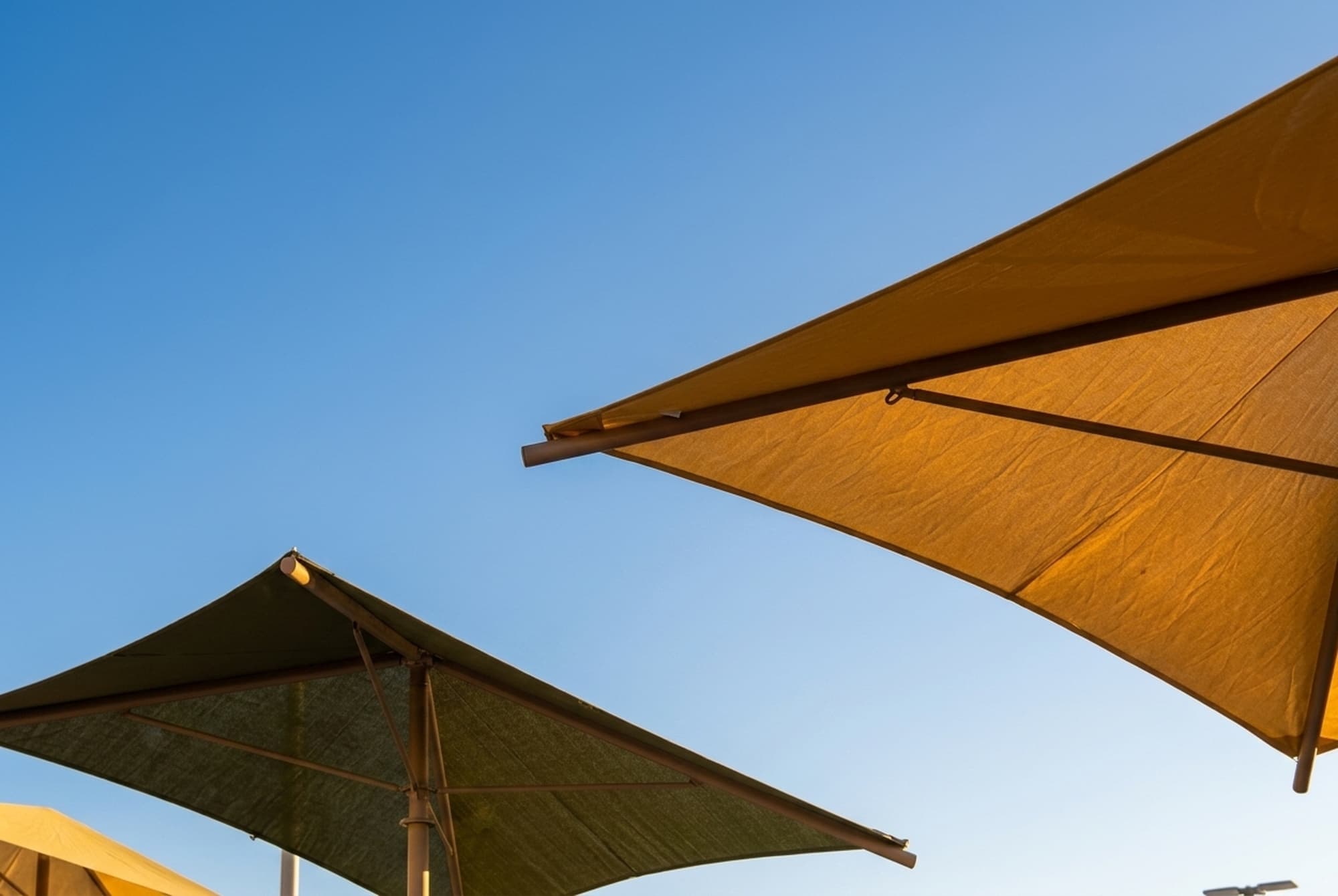
Styling Idea
Garden Umbrella Size and Base: A Practical Guide
An umbrella should shade the people, not just the table. Start from the area you want covered, then choose the shape and the base.
Size and shape
- Balcony or a small table: a compact round canopy, such as the Pamela (Ø 200 cm).
- Table for four to six: a round 3 m canopy, such as the Kalife (Ø 300 cm).
- Long tables or rows of tables: a rectangular canopy, such as the Hamel (300 × 400 cm).
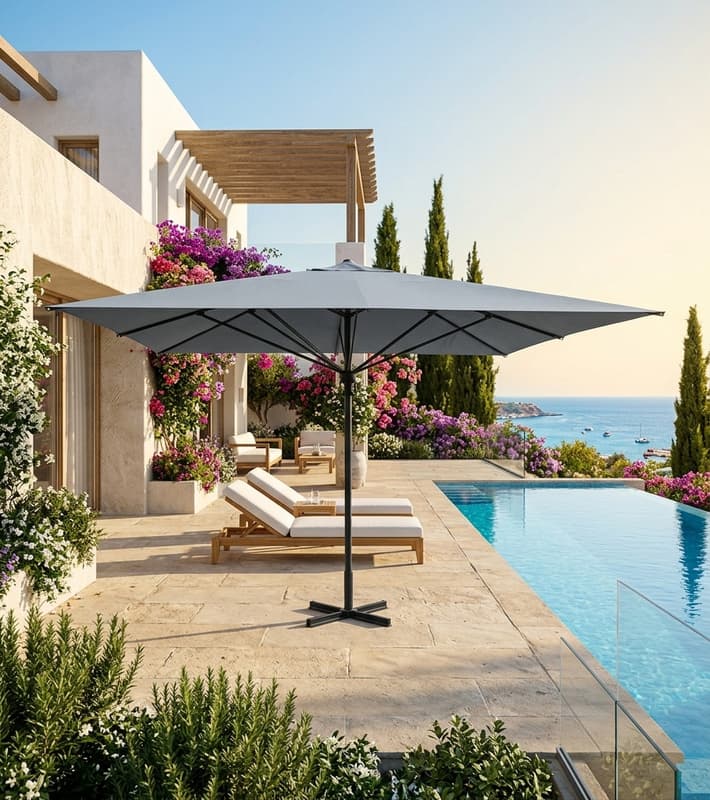
- Large terraces and pool areas: a large square canopy on a central pole such as the Deneb (495 × 495 cm), or a cantilever umbrella such as the Acrux (395 × 395 cm), which keeps the pole out of the seating area.
How much shade you actually get
The canopy is not the same as the shade. A common rule is to choose a canopy about 1-1.5 m wider than the table, so the chairs pulled out around it are covered too. In a Cyprus summer the midday sun is high and the shadow sits almost straight under the canopy, but by late afternoon it moves well to one side. That is the hour when a larger canopy, or one you can move, earns its place. Check the height as well: when open, the ribs should clear standing guests, and large models such as the Deneb and the Hamel stand 265 cm high.
Centre pole or cantilever?
A centre-pole umbrella goes through or next to the table and is the simpler option. A cantilever umbrella hangs the canopy from the side, so it can cover lounge seating or a table without a pole in the middle.
The base
The base has to match the umbrella: larger canopies and cantilever models need heavier bases than a small balcony parasol. Our bases range from wheeled models such as the Barry (35 kg, Ø 50 cm or 50 kg, Ø 58 cm) to a custom-made concrete base of 230 kg on wheels (80 × 80 cm). Before you order, check the pole diameter and the base weight the umbrella needs, and ask us which base fits your umbrella.
Choosing a base in practice
- Small parasols on a balcony: a wheeled base such as the Barry is easy to move around; the 35 kg version is Ø 50 cm, the 50 kg version Ø 58 cm.
- Stone ballast: the granite base with handle adds weight without taking much floor space, and the built-in handle helps you tilt and slide it.
- Commercial and cantilever umbrellas: a ballast frame such as the base for heavy-duty umbrellas (50 × 60 × 50 cm) is loaded with standard paving slabs bought locally, so it stays light to deliver. Note that the Acrux comes without a base.
- Through a table: the table hole steadies a centre-pole umbrella, but it does not replace a base of the right weight.
See all models in umbrella bases.
Wind and storage
Close the canopy when it gets windy or when the umbrella is not in use, and store it for the winter.
Canopy fabric and care
- Solution-dyed acrylic, as on the Pamela (light fastness 7/8, treated against stains and mildew), keeps its colour longest in strong sun.
- Polyester canopies, as on the Kalife and the Hamel, are lighter; the Hamel opens with a gas piston, which makes a large canopy easy to raise.
- PVC, as on the Deneb, gives solid shade and wipes clean.
- An air vent at the top, as on the Pamela, lets gusts escape instead of lifting the canopy.
Before winter, clean and dry the canopy, close it and keep it in a cover such as the Giove umbrella cover.
Common mistakes
- A base that is too light for the canopy, chosen to save space or money.
- Leaving the umbrella open overnight or when nobody is outside.
- Sizing the umbrella to the table top and leaving the chairs in the sun.
Browse all garden umbrellas and professional umbrellas, or find more ways to shade a terrace in our garden shade ideas.
Good to know
Frequently asked questions
Shop this setup
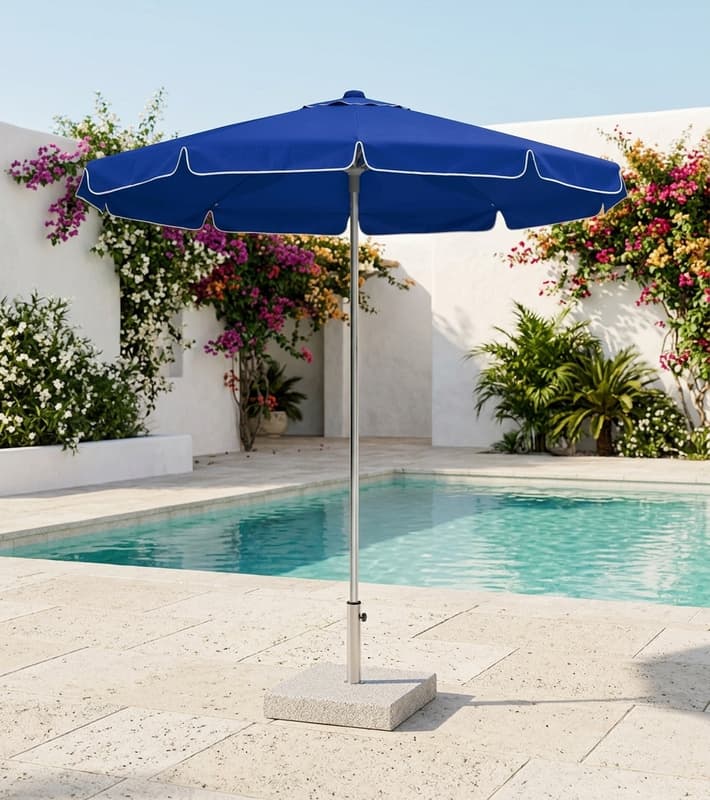
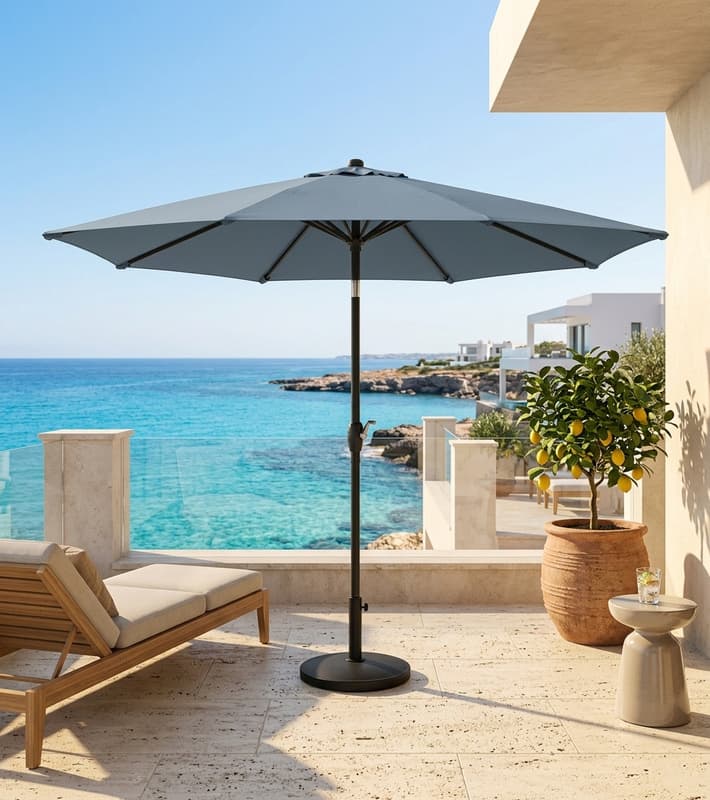
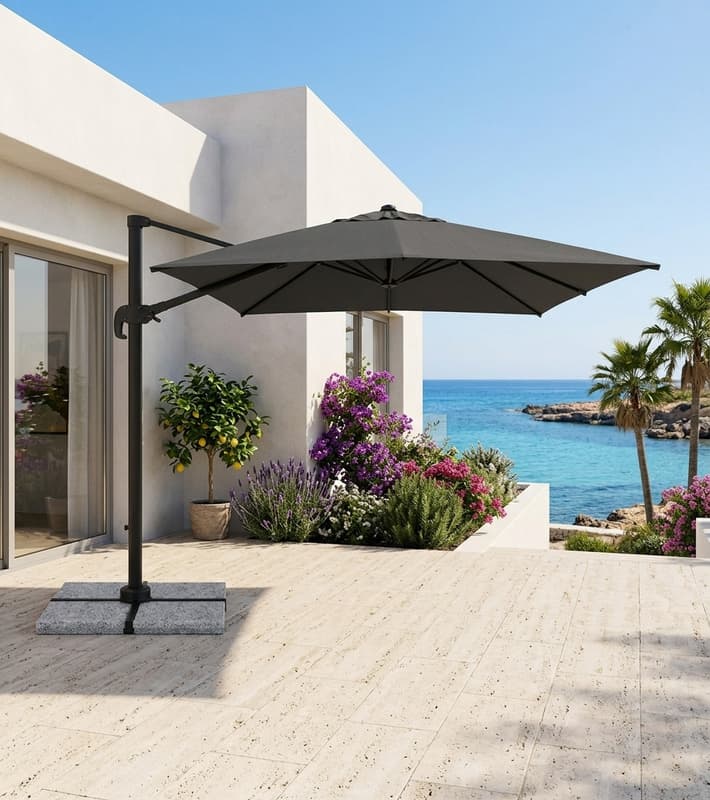
| UMBRELLA - PAMELA - D200CM | Umbrella - Kalife - D300cm | Umbrella - Hamel | Black umbrella DENEB with light grey canopy | |
|---|---|---|---|---|
| Price | €394.92 | €141.90 | €979 | €1208.90 |
| Material | Stainless steel | Aluminium | Polyester fabric | Aluminium |
| Dimensions | Ø200 cm | Ø300 cm | 300 × 400 × 265 cm | 495 × 495 × 265 cm |
| Color | Beige | 2 | 2 | 2 |
| Stackable | No | No | No | No |
| Cushions included | No | No | No | No |